


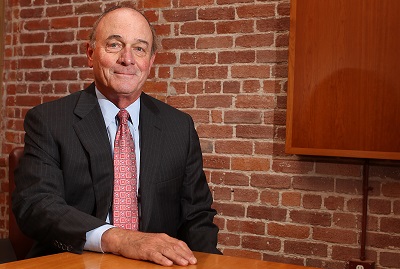
The water wars continue for Keker, who last year won the state's largest plaintiff verdict for client San Diego County Water Authority when a trial judge awarded $188 million in contract damages plus $43 million in prejudgment interest against the Metropolitan Water District of Southern California. In April, Keker sued the district again on San Diego's behalf, contending that its exorbitant water rates for 2016 and 2017 persist in ripping off his client. "The Met continues its stubborn and wrongheaded view," Keker said. "They are appealing last year's verdict and they remain greedy people, so we're suing them again." San Diego County Water Authority v. Metropolitan Water District of Southern California, BS161729 (L.A. Super. Ct., filed April 13, 2016).
In last year's case, San Francisco County Superior Court Judge Curtis E.A. Karnow invalidated the district rates then in place, holding they broke protected cost-of-service requirements and breached the district's water transportation agreement with the county. Nothing has changed, Keker said. Indeed, his expansive view of the dispute extends back in time to a series of U.S. Supreme Court rulings over distribution of Colorado River water between Arizona and California and the origins of the California State Water Project. Between 1931 and 2000, the high court looked at the issue 10 times in opinions all designated Arizona v. California. A key ruling came in 1963, when the justices specified the precise amount of water each state may take from the river. Keker's cases for San Diego show that matter remains unresolved. The appeal remains in briefing before the 1st District Court of Appeal.
Keker is currently pressing to remove the new lawsuit from Los Angeles to San Francisco to again get it before Karnow, an experienced jurist in the complex litigation department now well-schooled in the issues.
Meanwhile, Keker, a Marine veteran with a Purple Heart, has taken up the cause pro bono of WikiLeaks source Chelsea Manning, an Army soldier who is serving 35 years behind bars for espionage. Keker's argument, expressed in an amicus brief in May for Amnesty International to the U.S. Army Court of Criminal Appeals is that Manning was unconstitutionally held in solitary confinement at the Marine Corps Base Quantico for nine months before her trial. U.S. v. Manning, Army 20130739 (Army Crim. App., filed May 18, 2016).
Keker takes a dim view of the system that convicted Manning. "Military justice," he said, quoting the old saw, "is to justice as military music is to music."
— John Roemer
For reprint rights or to order a copy of your photo:
Email
Jeremy_Ellis@dailyjournal.com
for prices.
Direct dial: 213-229-5424
Send a letter to the editor:
Email: letters@dailyjournal.com