


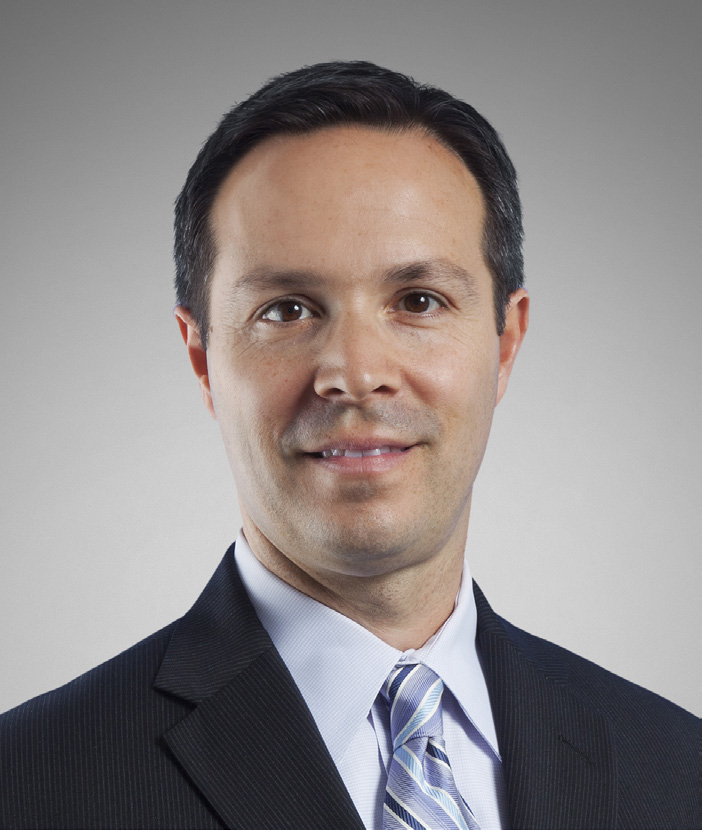
Calia has been a trial lawyer at Covington for over 25 years, focusing on complex civil litigation, with a particular emphasis on intellectual property and patent disputes. He has tried cases on a broad array of technologies for clients including Hewlett Packard, pharmaceutical companies Lundbeck and Takeda, and aerospace and defense company Elbit Systems of America.
He has handled several cases for Elbit in recent years and most recently resolved a long-running case brought by Thales Visionix against his client in federal claims court. Thales Visionix v. United States, 1:14-cv-00513- RTH. The patent infringement case brought by Thales, filed in 2014, is related to Elbit’s helmetmounted display systems used in the F-35 Joint Strike Fighter.
Elbit initially invalidated the Thales patent on patenteligibility grounds, but that decision was overturned on appeal by the Court of Appeals for the Federal Circuit. Elbit successfully invalidated the majority of the asserted patent claims via inter partes review in the Patent Trial and Appeal Board.
“For us, the details associated with how the helmets actually work were grounded in source code, and we had taken the position from the get-go that there was no prospect of Thales being able to demonstrate infringement. We made available an enormous amount of source code, and basically said, go see if you can find some basis to claim infringement. We were confident that there was no basis to claim infringement and moved for summary judgment,” Calia said. “We thought the Thales case sufficiently weak that we took the unusual step of bringing a Rule 11 motion for sanctions, saying that the case shouldn’t have been filed in the first instance.”
Thales was unsuccessful in its efforts to convince the court to deny the motions while the parties pursued additional discovery. After seven years of litigation, the parties negotiated a settlement late last year, by which the case was dismissed with no payment owed by Elbit.
In addition to his practice, Calia is a frequent lecturer on intellectual property developments and has taught IP courses at Berkeley Law School and Howard University Law School.
“I’ve had some of my former students go on and pursue careers in intellectual property, in private practice or in-house. It’s neat to see that, to feel like I had some positive influence on their career trajectory,” he said.
Calia, who studied molecular biology in college, also draws inspiration from the scientific luminaries he gets to rub elbows with. In a patent infringement case for Lundbeck and Takeda over the antidepressant Trintellix, Calia took the expert testimony of Dave Macmillan, a professor of chemistry at Princeton. A month after the court issued its decision, Macmillan won the Nobel Prize in chemistry.
“Being able to work with a scientist of that caliber was a highlight,” Calia said. “I get to work with people who are truly world-renowned for what they do.”
– Jennifer Chung Klam
For reprint rights or to order a copy of your photo:
Email
Jeremy_Ellis@dailyjournal.com
for prices.
Direct dial: 213-229-5424
Send a letter to the editor:
Email: letters@dailyjournal.com