


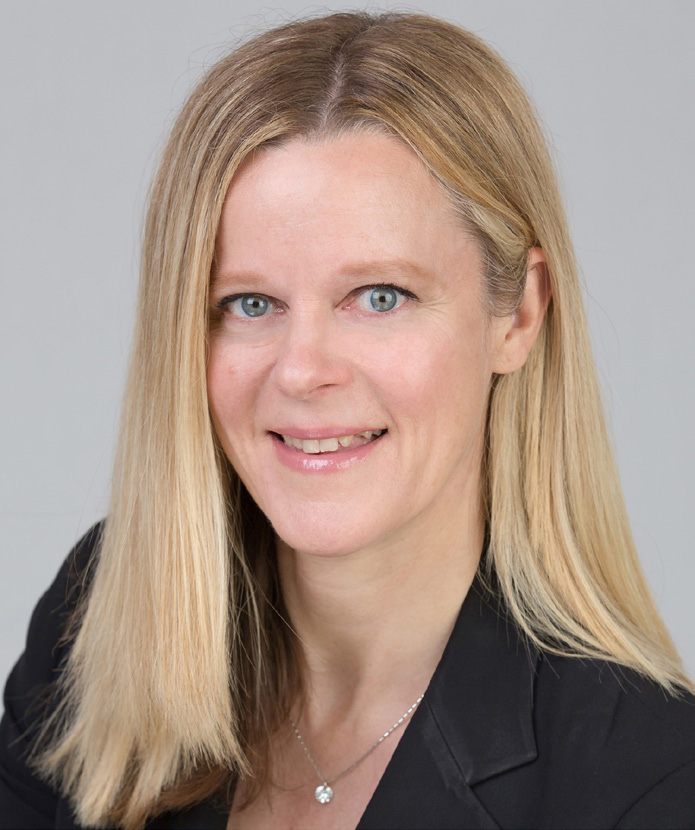
Morgan has made herself into one of the country’s leading experts in what is and what is not an abstract idea under Section 101 of U.S. patent law — that is, the Alice defense. She regularly helps clients avoid millions of dollars in potential liability by invalidating patents at the pleading stage.
“Of the patents I’ve challenged, none have been found patent-eligible,” she said.
Another measure of her skill is this: “I have companies come to me who already have counsel and have me rewrite their Alice motions… without telling the outside lawyers that I’m doing that.” It happens “a lot,” she said.
Morgan doesn’t necessarily fault those other lawyers. After all, she said, this is “a murky area of the law because it needs to evolve. It’s very difficult for lawyers and judges to put their arms around. There’ve been a lot of twists and turns since the Alice case came down in 2014.” Alice Corp. v. CLS Bank International, 573 U.S. 208 (2014).
In one of her successful matters, she represented one of over two dozen defendants sued by a company called Pebble Tide Inc. for infringing two patents dealing with moving data from one device to another via the cloud, as Morgan described it. The patents were declared ineligible.
“[The plaintiffs] sued so many different companies for so many different things, you could tell that they were just trying to read their patents on anything that sent data through the cloud,” including Disney, she said. Pebble Tide LLC v. Arlo Technologies Inc., 1:19-cv-00769 (D. Del., filed April 27, 2019).
In some ways, that case was similar to another she handled a couple of years before. She and co-counsel represented GE to invalidate a patent that described a way to collect patient data in varying formats from several medical devices, convert them and then display them together in a graphical user interface, Morgan said.
“That’s an interesting idea, but it’s abstract because the patent didn’t really tell you how to do that,” she said. “That’s the problem with these software patents. They’re so broad, and they don’t really tie it down to a particular technical improvement.”
The patent owner was an arm of the University of Florida, which also raised a sovereign immunity claim unsuccessfully. University of Florida Research Foundation Inc. v. General Electric Co., 916 F.3d 1363 (Fed. Cir., Feb. 26, 2019).
Morgan said she has consulted behind the scenes a few times with clients who wanted to see their patents upheld, but none of those matters went to a decision by a court.
Recently, she proposed to a law school that she teach a class on the Alice doctrine “because it is so hard to [boil] down in a short conversation or in a simple way.” The topic might be better for an LL.M. or professional-level class, she added.
“I’ve got to dump all this knowledge out on somebody at some point.”
– Don DeBenedictis
For reprint rights or to order a copy of your photo:
Email
Jeremy_Ellis@dailyjournal.com
for prices.
Direct dial: 213-229-5424
Send a letter to the editor:
Email: letters@dailyjournal.com